Wednesday, February 2, 2011

An unanticipated problem with Vermilion

Vermilion Flycatcher males are so intensely red they positively glow in the sun, which ultimately led me to have a very big problem with getting a decent image of them. Basically the red channel saturates and blocks up quite quickly, especially in situations with a lot of contrast between the sunlit head and the shaded breast, like the above. And once the red saturates too far Lightroom (and probably most other RAW processors) map the overexposed red to white. I did a little bit of masking on the head to get around this problem (which otherwise makes the bird look glossy).

The other thing I noticed is an apparent reduced level of detail compared to what I was expecting. This probably has a lot to do with the saturation of the red color in the first place, but I'm not sure if the Bayer sensor (which is RGGB, and therefore may be less accurate with pure reds and blues than it is with greens) had a role to play in this too. Ironically, I got better feather detail from shots in more overcast conditions than I got in sunlight. But with Vermilion Flycatcher I will take what I can get - they do not seem that willing to let me approach them very much, and they are quite a small bird.

Tuesday, February 1, 2011

Orange-crowned Warbler

Orange-crowned Warblers apparently have a sweet tooth. While I saw lots of Orange-crowned and Yellow-rumped down in the Rio Grande Valley in Texas recently, it was the Orange-crowned visiting the grapefruit, oranges, nectar feeders and these bottle brush plants at the convention center at South Padre Island. Yellow-rumped seemed fonder of peanut butter. This bird is probably a first winter immature (flight feathers not seen well).

Crested Caracara


Crested Caracaras usually watch me long enough to stop the car and then exit the scene. This undoubtedly reflects the tendency of bozos to shoot at them. So of course this especially tame adult at Laguna Atascosa NWR in Texas was actually a little too close for my 800mm lens, and I couldn't quite cram all of it in the frame. Nevertheless the amount of resolved detail in the full-size image is startling (not so obvious in a smaller JPG like this).

Wednesday, December 29, 2010

Dunlin

A basic plumaged individual resting on rocks at Barnegat Inlet in NJ

Wednesday, December 15, 2010

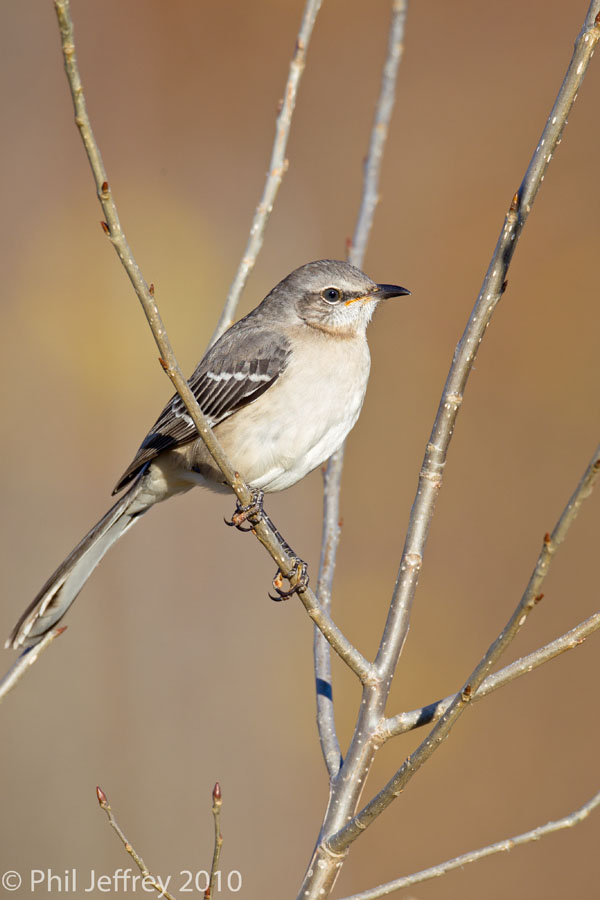
Northern Mockingbird immature

This Northern Mockingbird that was one of several at Cove Island Park in CT on my second visit to the Fork-tailed Flycatcher. Mockingbirds were harassing the FTFL quite a lot that day - I've had a persistent problem with winter-territorial mockingbirds in my back yard as they can be quite belligerent. This individual was a little tamer and often this is seen with immature birds. Correspondingly the somewhat sharper tail feather profile suggests first winter age, as does the gray iris. Pyle's ID book warns that eye color is not definitive and that some adults can show green or even gray, but in this case it's nicely consistent with the tail profile. This bird is also a little browner than most around the throat and shows quite a bit of yellow in the gape.

Thursday, December 9, 2010

Hermit Warbler


The first Hermit Warbler on the NY state list, this first fall female was at Sunken Meadow State Park on Long Island, spending most of its time feeding on the grass. The previous bird, in 2002, was judged to be a Townsend's X Hermit hybrid.

Tuesday, December 7, 2010

White-throated Sparrow

This popped up in some colorful foliage while I was waiting for a Varied Thrush to be more cooperative. At the time the lighting was overcast, which made for subdued lighting with strong saturation. I believe this is an immature based on the flank streaking, rather than an adult tan stripe morph. Shot with an 800mm f5.6/L-IS on a 1D Mark IV.