Showing posts with label NJ. Show all posts

Tuesday, December 27, 2011

Unusual Ruddy Turnstone


In the lower image the typical appearance of winter-plumaged Ruddy Turnstone is in the lower left-hand corner. A Purple Sandpiper is in the middle, and this rather atypical Ruddy is at the top right. The top image shows what it looks when it's walking around feeding - demonstrably a Ruddy Turnstone but with no paler rufous fringing and a very extensive breast mark. Although Ruddy Turnstone and Black Turnstone overlap in breeding range in Alaska there's actually nothing in this bird to indicate a Black Turnstone hybrid - it's just a very dark Ruddy and one that really stuck out from all the other 40+ Ruddies that were roosting on the side of Barnegat Inlet jetty. I've considered melanism (or some other color defect) as a possible explanation - it's interesting that at least in the "group" photo the legs are noticeably a darker shade than the other Turnstone.

Friday, July 8, 2011

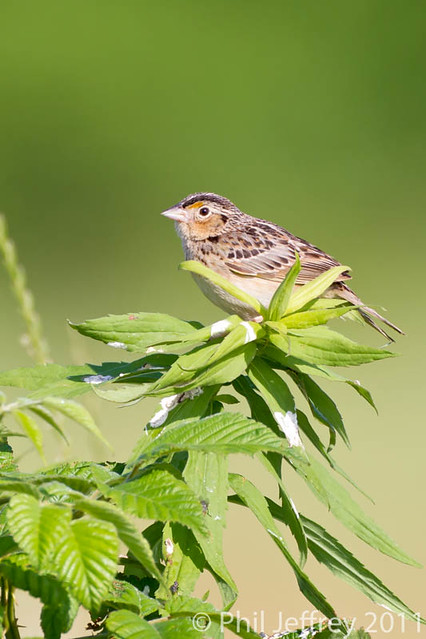
Late spring: Grasshopper Sparrow

Spring migration didn't produce an epic flood of photos, and I was between two trips (LA-TX, mainly work with a little birding; OR-WA, birding and photography) when I ventured out into Franklin Twp to check the grasslands. I found this male Grasshopper Sparrow perched up singing away - although not a tall shrub it was the tallest one in the field and this was obviously a frequent singing perch (see the whitewash) from which this male was singing for an extended period.

Monday, March 28, 2011

Glaucous Gull


First winter (or perhaps given the late date, better to say "first cycle") Glaucous Gull in rather worn plumage, taken on an NJ pelagic. Although in this case we were very much inshore, perhaps only a mile or three off the coast. The mass of the bird is rather well shown in this instance - chunky body, broad wings, but the tail is in all sorts of disrepair. However the size of the bird wasn't appreciably greater than the multitude of Herring Gulls.

This pelagic was not at all productive for actual pelagic species, but having a Glaucous Gull soar over my head was a decent consolation prize. Other gulls included two Icelands (the immature was the more cooperative of the two) and two Lesser Black-backed.

Tuesday, June 8, 2010

Willow Flycatcher


These are (probably) two different male Willow Flycatchers in two adjacent territories from two successive years at a local grassland preserve. Most of the Willow Flycatchers I encounter are not very friendly, but sometimes you find an especially hormonal one that is perhaps still looking for a mate. The one from 2009 kept shuttling between bush tops proclaiming territory and eventually briefly stopped in a position when I could take a photo. The one from 2010 was a much more assertive bird - in fact at one point I wasn't sure that it wasn't singing at me - and it may or may not be associated with it being in more marginal territory with less cover. The 2010 male has fewer perches and is considerably less shy in singing from them. It's almost certainly unpaired, although I don't monitor breeding success in this location. There are at least two other Willow Flycatcher territories in this general area, and they are by no means a rare bird in the right habitat in NJ.